What to Look for in a Similar Game
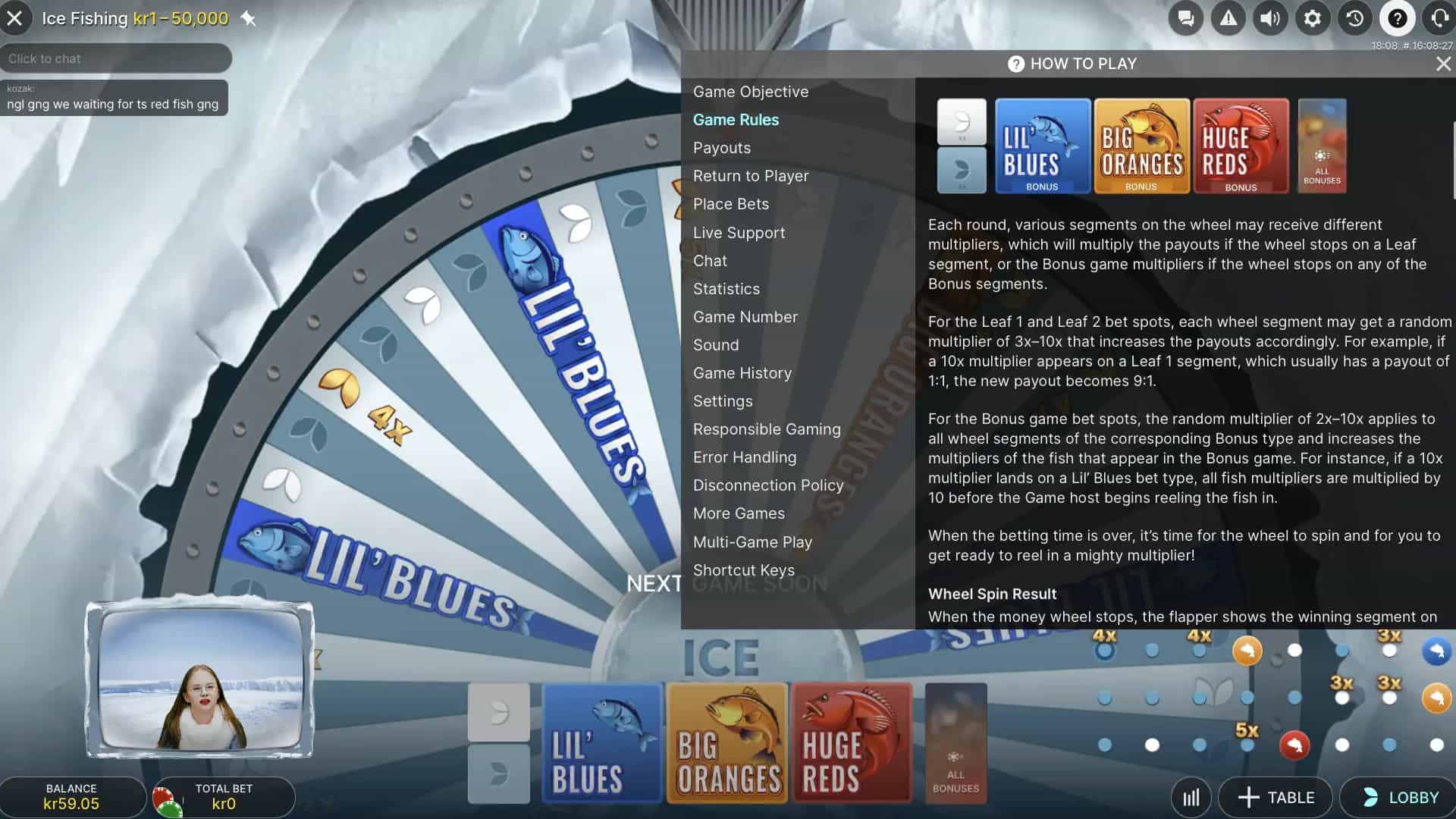
- Live host and game show format — The defining feature of Ice Fishing is its hosted, broadcast-style presentation. Any meaningful alternative should feature a professional presenter who drives the action and adds entertainment value, not just an automated RNG wheel.
- Wheel or central random mechanic — Ice Fishing uses a 53-segment wheel as its core decision engine. The most comparable titles share this wheel-based structure, though some substitute pachinko boards, prize walls, or dice-based bonus triggers.
- Bonus rounds with escalating multipliers — The three-tier bonus system (Lil' Blues, Big Oranges, Huge Reds) is central to Ice Fishing's appeal. Alternatives worth considering offer their own bonus layers rather than paying out only from the base wheel.
- Provider pedigree — Evolution created the live game show category and continues to dominate it. Most high-quality alternatives come from the same studio, ensuring comparable production values, stream quality, and regulatory compliance.
- Maximum multiplier ceiling — Ice Fishing caps at 5,000x. Players chasing bigger theoretical peaks may prefer titles that reach 10,000x or even 25,000x, while those who value more frequent modest wins may gravitate toward lower-volatility shows.
Top Game Shows That Play Like Ice Fishing
Crazy Time
Crazy Time is often considered the flagship of Evolution's game show lineup and is the title most frequently compared to Ice Fishing. The game centres on a 54-segment wheel — just one segment more than Ice Fishing's 53 — but the similarity in wheel size belies a significant difference in bonus complexity. Crazy Time features four distinct bonus games: Cash Hunt (a grid-based prize shooter), Pachinko (a plinko-style dropping disc), Coin Flip (a two-sided coin with multipliers), and the Crazy Time bonus itself (a massive secondary wheel). This four-bonus structure means players encounter more variety per session, but it also introduces higher variance. The theoretical maximum multiplier reaches 25,000x, dwarfing Ice Fishing's 5,000x ceiling, though payouts at that extreme are exceptionally rare. Crazy Time suits players who want maximum entertainment density and are comfortable with significant swings in their balance.
Monopoly Live
Monopoly Live merges the money wheel format with the intellectual property of the world's most famous board game. The wheel includes numbered segments and Chance-card positions, but the real draw is the 3D bonus round. When triggered, players are taken to a virtual Monopoly board where Mr. Monopoly rolls dice, moves across properties, and accumulates multipliers through building houses and hotels. The interactive element gives the bonus round a narrative arc that is more involved than Ice Fishing's fishing mechanic, though the core idea — a wheel leading to a secondary multiplier event — is structurally identical. The maximum multiplier can climb to 10,000x, doubling Ice Fishing's cap. Monopoly Live is ideal for players who enjoy thematic storytelling and a bonus round that unfolds over multiple steps rather than a single reveal.
Dream Catcher
Dream Catcher holds a special place in the game show category as the title that started it all. Launched by Evolution in 2017, it was the first live casino game to use a money wheel hosted by a live presenter. The wheel is segmented into cash values (1, 2, 5, 10, 20, 40) along with two multiplier positions (2x and 7x). There are no bonus rounds, no secondary games, and no themed sets — just the wheel and the host. This simplicity is Dream Catcher's greatest strength for newcomers: the rules take seconds to understand, and every spin delivers an immediate, transparent result. The trade-off is a lower excitement ceiling. Without bonus mechanics, Dream Catcher cannot match the dramatic peaks of Ice Fishing or Crazy Time. It is the right choice for players who find multi-layered bonus structures more confusing than exciting.
Lightning Storm
Lightning Storm takes a different structural approach from the rest of the game show family. Instead of a physical or virtual wheel, the game uses a grid-based layout where random lightning strikes add multipliers to selected positions. The host oversees the process, but the mechanic is closer to a lottery draw than a wheel spin. What makes Lightning Storm relevant to Ice Fishing fans is its high volatility: the random multiplier application can produce dramatic swings, mirroring the feast-or-famine dynamic of hitting a Huge Reds bonus versus enduring a string of non-bonus spins. The visual style is more futuristic than Ice Fishing's Arctic theme, and the pace is similarly brisk. Lightning Storm appeals to players who enjoy high variance but want a format that feels distinct from the standard wheel paradigm.
Funky Time
Funky Time wraps the money wheel format in a 1970s disco theme, complete with a dance floor, retro lighting, and a host who embraces the era's flamboyance. The wheel includes four bonus segments — Stayin' Alive, Disco, Bar, and VIP Disco — each with its own multiplier mechanic. The maximum payout reaches 10,000x, and the frequency of bonus triggers sits between Dream Catcher's zero-bonus design and Crazy Time's four-bonus density. What distinguishes Funky Time from Ice Fishing is not the structure but the atmosphere: where Ice Fishing is frosty and suspenseful, Funky Time is vibrant and celebratory. Mechanically, both games share a wheel-plus-bonus architecture, making Funky Time a natural alternative for players who enjoy the Ice Fishing format but prefer a warmer, more energetic visual tone.
The Stayin' Alive bonus in Funky Time is worth highlighting for Ice Fishing fans specifically. It features a dance-floor grid where the host moves across tiles, each hiding a multiplier. The gradual reveal of multipliers — stepping on one tile at a time — creates a suspense arc similar to Ice Fishing's piece-by-piece fish reveal, though the setting and tone are completely different. If the slow-build anticipation is what hooks you about Ice Fishing's bonus rounds, Funky Time's Stayin' Alive delivers that same emotional trajectory in a disco wrapper.
Availability for Canadian Players
All six game shows discussed in this guide are developed by Evolution and distributed through the same B2B platform. For Canadian players, this means availability depends on whether your chosen online casino has integrated Evolution's game show catalogue. In Ontario's regulated iGaming market, most licensed operators carry the full Evolution game show suite, so you should find Ice Fishing, Crazy Time, Monopoly Live, Dream Catcher, Lightning Storm, and Funky Time in the same lobby. Outside Ontario, availability may vary by operator and provincial regulation, but Evolution's dominant market position means its titles are present at the vast majority of sites serving Canadian players.
One practical advantage of all these games sharing a single provider is consistency. The user interface, betting panel layout, chat system, and streaming quality are standardized across Evolution's game show portfolio. If you learn to navigate Ice Fishing's interface, you already know how to place bets in Crazy Time or Funky Time — the controls are virtually identical. This reduces the learning curve when switching between titles and makes it easy to sample multiple shows in a single session without fumbling with unfamiliar layouts.
Demo versions are available for most of these titles as well, allowing you to try each game without financial commitment. If you are reading this page because you enjoy Ice Fishing and want to explore alternatives, playing the demo of Crazy Time or Monopoly Live is the fastest way to determine whether the mechanics and atmosphere suit your preferences. The demos use the same RNG engines as the live versions, so the gameplay you experience in free-play is representative of the real thing.
Side-by-Side Feature Comparison
| Game | Provider | Core Mechanic | Bonus Rounds | Max Multiplier |
|---|
| Ice Fishing | Evolution | 53-segment virtual wheel | 3 (Lil' Blues, Big Oranges, Huge Reds) | 5,000x |
| Crazy Time | Evolution | 54-segment wheel | 4 (Cash Hunt, Pachinko, Coin Flip, Crazy Time) | 25,000x |
| Monopoly Live | Evolution | Money wheel with Chance segments | 1 (3D Monopoly board) | 10,000x |
| Dream Catcher | Evolution | Money wheel with multiplier slots | 0 (multiplier respin only) | Dependent on multiplier chain |
| Lightning Storm | Evolution | Grid with random lightning multipliers | Lightning mechanic (integrated) | High (varies per round) |
| Funky Time | Evolution | Money wheel with disco theme | 4 (Stayin' Alive, Disco, Bar, VIP Disco) | 10,000x |
Choosing the Right Game Show for Your Style
- Assess your volatility tolerance — Dream Catcher sits at the low end: steady, small wins with no bonus-driven spikes. Ice Fishing occupies the middle ground with three bonus tiers. Crazy Time and Lightning Storm sit at the high end, where long dry spells can be followed by transformative payouts. Match the game to your comfort with variance.
- Count the bonus rounds you want — If you enjoy bonus variety, Crazy Time (four bonuses) and Funky Time (four bonuses) offer the most. Ice Fishing provides three, Monopoly Live has one deep bonus, and Dream Catcher has none. More bonus rounds mean more variety per session but also more complexity to learn.
- Consider visual and thematic preference — Theme has no effect on odds, but it affects enjoyment. Ice Fishing's Arctic setting appeals to players who like cool, suspenseful atmospheres. Funky Time is the opposite — warm, loud, and celebratory. Monopoly Live attracts board game nostalgia. Pick the aesthetic that will keep you entertained over dozens of rounds.
- Compare maximum multiplier potential — If the size of the theoretical ceiling matters to you, Crazy Time leads at 25,000x, followed by Monopoly Live and Funky Time at 10,000x, then Ice Fishing at 5,000x. Remember, higher ceilings generally come with lower hit frequencies — the largest wins are the rarest events.
Volatility and Session Expectations
Understanding volatility is essential when choosing between game shows because it directly affects your session experience. A low-volatility game like Dream Catcher produces relatively frequent, small payouts — your balance moves gently up and down, and dramatic swings are rare. A high-volatility title like Crazy Time or Lightning Storm behaves differently: you may go through extended stretches of modest or losing results before a single bonus round delivers a payout that reshapes the entire session. Ice Fishing sits in a middle zone — its Lil' Blues bonus triggers often enough to keep the balance active, while Huge Reds provides the high-volatility spike for those who stay patient.
For Canadian players, volatility preference often correlates with available bankroll and session length. If you play occasionally with a modest budget, a lower-volatility show ensures you get more entertainment per dollar, even if the peak payouts are smaller. If you play regularly and can absorb dry spells without frustration, higher-volatility titles offer the chance for those session-defining moments that keep you coming back. There is no objectively correct choice — only the one that matches your financial comfort and emotional appetite for risk.
One practical way to assess your own tolerance is to play demo versions of several shows back-to-back. Track your emotional responses across 20 to 30 rounds in each demo. Does the steady drip of Dream Catcher payouts feel satisfying or boring? Does the long wait between Crazy Time bonuses feel exciting or frustrating? Does Ice Fishing's three-tier structure hit a comfortable middle ground? Your gut reactions in the demo are the most reliable guide to which show you will enjoy — and sustain — with real money on the line.
How Ice Fishing Stands Apart
| Comparison Point | Ice Fishing | Other Game Shows |
|---|
| Theme and setting | Arctic ice-fishing environment with a frosty colour palette and winter sound design. The setting is unique within the Evolution catalogue — no other title uses a fishing or cold-weather motif. | Themes range from disco (Funky Time) to board games (Monopoly Live) to generic studio sets (Dream Catcher). Most use warm or neutral palettes. |
| Bonus reveal mechanic | A gradual, piece-by-piece fish reveal that builds suspense as the catch is reeled in. The size of the fish determines the multiplier, and the slow reveal is a core entertainment feature. | Bonuses resolve through instant number reveals (Coin Flip), grid selections (Cash Hunt), dropping discs (Pachinko), or animated board walks (Monopoly). Most are faster than Ice Fishing's deliberate reveal. |
| Number of bonus tiers | Three distinct tiers (Lil' Blues, Big Oranges, Huge Reds), each with its own multiplier range. This creates a layered risk profile within the bonus system itself. | Ranges from zero (Dream Catcher) to four (Crazy Time, Funky Time). Only Ice Fishing explicitly tiers its bonuses by multiplier range rather than offering structurally different games. |
| Maximum multiplier | 5,000x — competitive but not the highest in the Evolution lineup. | Ranges from relatively modest (Dream Catcher) to 25,000x (Crazy Time). Ice Fishing sits in the mid-to-upper range. |
| Wheel segment count | 53 segments — slightly below the most common count of 54 (Crazy Time) but more than simpler wheels like Dream Catcher. | Varies from roughly 48 segments (Dream Catcher style) to 54 or more. Segment count affects outcome distribution but is rarely a deciding factor for most players. |
Exploring Beyond the Wheel Format
While this guide focuses on wheel-based game shows, it is worth noting that Evolution's live catalogue includes formats that may appeal to Ice Fishing fans for different reasons. Lightning Roulette, for instance, is technically a roulette variant but includes random lightning multipliers of up to 500x on straight-up bets — a mechanic that echoes the multiplier excitement of Ice Fishing's bonus rounds. Similarly, Mega Ball combines a lottery-style ball draw with multiplier cards, creating a communal anticipation experience that mirrors the shared excitement of watching a bonus fish emerge from the ice.
If you find yourself drawn to Ice Fishing primarily for the suspense of the reveal — the slow ascent of the fishing line, the growing silhouette beneath the ice — look for games that emphasize anticipation over speed. Monopoly Live's extended board walk and Crazy Time's multi-stage Pachinko drop both scratch that same itch. Conversely, if the fast pace of the base wheel is what keeps you engaged, Coin Flip rounds in Crazy Time and the rapid payouts of Dream Catcher may feel more aligned.
Ultimately, the beauty of Evolution's game show family is that each title offers a slightly different flavour of the same core experience: a live host, a random mechanic, and the possibility of a multiplier that transforms a modest bet into a significant payout. Ice Fishing handles these elements with an Arctic twist and a unique tiered bonus system, but it is not an island — it is part of a broader ecosystem where trying multiple titles is the best way to find your personal favourite.
Building a Multi-Show Session Strategy
Many experienced Canadian players do not commit to a single game show for an entire session. Instead, they rotate between two or three titles, using each to serve a different purpose within their overall entertainment budget. A common approach is to open with Dream Catcher — its simplicity and low volatility serve as a warm-up that lets you settle into the live game show rhythm without exposing your bankroll to large swings. Once you are comfortable and have a feel for the pace, you transition to Ice Fishing or Crazy Time for the bonus-driven excitement that forms the core of the session. If the higher-volatility show produces an early win, you lock in the profit and either close the session or return to a lower-volatility title to play with house money.
This rotation strategy is not about changing the mathematical odds — each game's RNG is independent of the others — but about managing your psychological state and bankroll exposure over time. Variety prevents the fatigue that can set in after dozens of identical rounds, and switching between different visual environments (Dream Catcher's neutral studio, Ice Fishing's Arctic set, Funky Time's disco floor) keeps the entertainment value high. The fact that all of these titles share the same Evolution interface means you can switch between them seamlessly without re-learning controls or adjusting to a different platform.
For budgeting purposes, allocate your session bankroll across the titles you plan to play rather than pouring everything into one game. If your total budget is $100, you might allocate $30 to Dream Catcher warm-up rounds, $50 to your main Ice Fishing session, and $20 to an exploratory stint in Crazy Time or Funky Time. This distribution ensures that no single title can consume your entire budget, and it forces natural stopping points when one allocation runs out. It is a simple discipline that extends your total playing time and maximizes the variety of your experience.